We are a group of Columbia University students, researchers, alumni, and friends, devoted to the practice and study of Tibetan Buddhism. We follow the teachings and practices of the ancient translation school of Nyingmapa. Our practice and study is based mainly on the Palyul Nyingma Lineage, as well as other Tibetan Buddhist traditions. These are our sources for transmission and instruction. The Great Lord of Refuge Drubwang Pema Norbu is our Root Lama and the source of our transmission and inspiration.
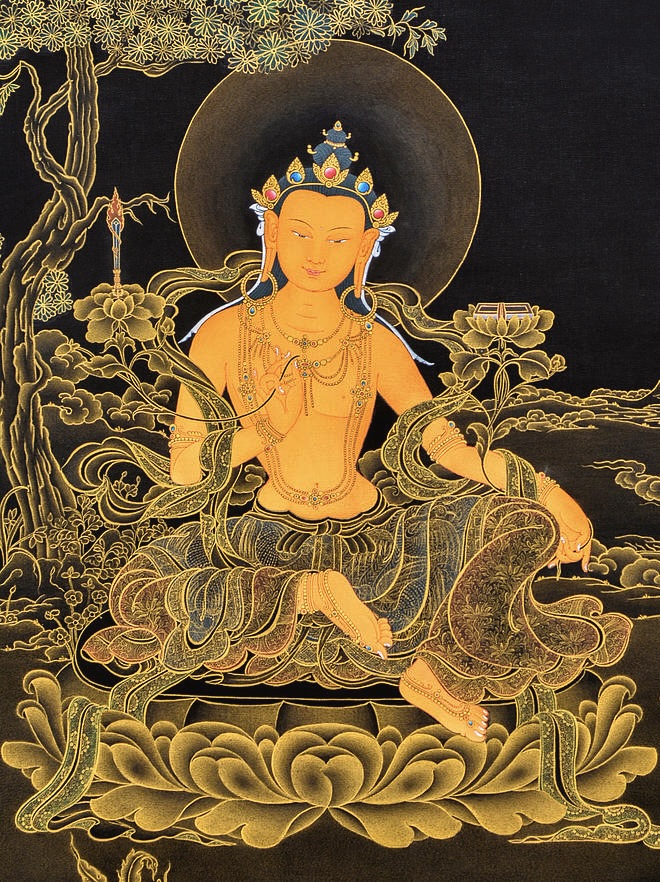
The Great Wisdom Deity Manjushri
Studying Tibetan Buddhism
We offer a regular weekly schedule of classes on many aspects of Buddhist history, philosophy, and meditation. Every session includes teaching, discussion, and meditation.
Meditation Practice
Meditation is the foundation of Buddhism in all traditions. Instruction and group practice are offered weekly. CUTBC teaching and meditation meetings are offered in-person on the Columbia campus and streamed live on Zoom.Contact us for more information.
A Very Brief History of the Nyingma Lineage of Tibetan Buddhism
The Nyingma school is the oldest of the four major schools of Tibetan Buddhism, founded by Vajrayana revealer Guru Padmasambhava. “Nyingma” literally means “ancient,” and is often referred to as Nga gyur nying ma སྔ་འགྱུར་རྙིང་མ། “school of the ancient translations” or “old school”. The Nyingma school is founded on the first translations of Buddhist scriptures from Sanskrit into Old Tibetan in the eighth century, during the reign of King Trisong Detsen. The Tibetan alphabet and grammar was created for this endeavor.
Of the three main vehicles of Buddhism – the Hinayana, the Mahayana and the Vajrayana – the Nyingma school is of the highest and most direct method for the attainment of enlightenment, the Vajrayana. The Vajrayana is also known of as Tantra.
The Vajrayana of the Nyingma school traces its origins to an emanation of Amitabha and of Avalokitesvara, Guru Padmasambhava, whose coming and activities were predicted by Buddha Shakyamuni, which supports the school’s view that Padmasambhava is the second Buddha. Nyingma origins are also traced to Garab Dorje and to Yeshe Tsogyal.
The Nyingma school has a Kama lineage and a Terma lineage. The Kama lineage is the oral transmission lineage, and is called the “source of Nyingma tradition” by Nyingma scholar Khenchen Palden Sherab Rinpoche. It is further stated by Khenchen Palden Sherab Rinpoche that from the time of Guru Padmasambhava and for at least three centuries afterwards, everyone who attained enlightenment in Tibet did so by practicing the kama lineage teachings of the Nyingma school.
The Kama lineage remained predominant from the 8th to 11th century, and Kama masters taught from the lineage’s teachings. The Terma lineage is the revealed transmission lineage where Tertons, or treasure revealers, realize the teachings. The arising of the Terma lineage began in the 11th century, and by the 14th century Tertons were more sought as teachers than Kama masters. The Terma lineage was established by Guru Padmasambhava and Yeshe Tsogyal, through the hiding of teachings for the purpose of future discovery. The Kama is the basis of the Terma.
The Nyingma Kama lineage begins with Padmasambhava, Shantarakshita, Vimalamitra, and Vairochana. The Nyingma Dzogchen lineage was transmitted directly from Garab Dorje to Padmasambhava.
The Nyingma school arose as the first Tibetan Buddhist school, in the atmosphere of Bon practices which had previously formed the primary basis of Tibetan spiritual beliefs.
Short biography of our root guru Penor Rinpoche
Life in Tibet The Third Drubwang Padma Norbu Rinpoche, Thubten Legshed Chokyi Drayang ཐུབ་བསྟན་ལེགས་ཤད་ཆོས་ཀྱི་སྒྲ་དབྱངས།, also known as Do-ngag Shedrub Tenzin Chog-lei Namgyal ཐུབ་བསྟན་ལེགས་ཤད་ཆོས་ཀྱི་སྒྲ་དབྱངས།, was born in 1932, the year of the Water Monkey, in the twelfth month, in the Powo region of Kham, East Tibet. He was recognized in 1936 by the Fifth Dzogchen Rinpoche (Thubten Chokyi Dorje) and Khenpo Ngawang Palzang (also known as Khenchen Ngagi Wangchuk, Ngawang Palzangpo, or Khenpo Ngagchung). Padma Norbu was formally enthroned by his root teacher, Thubten Chökyi Dawa (1894–1959) the second Chogtrul Rinpoche, and Karma Thegchog Nyingpo (1908–1958) the Fourth Karma Kuchen. He trained at the Palyul Monastery in Tibet, studying and receiving teachings from numerous masters and scholars, including the Fourth Karma Kuchen, the 10th Palyul throne holder.
Establishment in India In 1959 Penor Rinpoche left Eastern Tibet with a party of 300 for Pemako in Northeast India. In 1961 they were resettled in South India in Bylakuppe in a series of Tibetan camps where Penor Rinpoche initially built a bamboo temple to train a small handful of monks in 1963.
Life in India In the 1970s, Penor Rinpoche began to train Khenpos in the Nam Cho cycle. By the 1980s Namdroling Monastery had many hundreds of monks. In 1993 a nunnery was added, and by 2004 there were 4000 monks and 800 nuns at the monastic center.
Teachings in Western countries He made his first visit to the United States in 1985, invited by Gyaltrul Rinpoche to Ashland, Oregon, to confer the Nam Cho cycle of teachings. In 1988 he gave the Kama teachings at Gyatrul Rinpoche’s Yeshe Nyingpo center in Ashland, Oregon, followed immediately thereafter by the Longchen Nyingthig at Ven. Peling Tulku Rinpoche’s centre in Canada, Orgyan Osal Cho Dzong. After this he gave the Rinchen Terzod empowerments at Kunzang Palyul Choling. Towards the end of this cycle of empowerments he ordained 25 western monks and nuns. In 1995 he give teachings and empowerments for a week in New York City. He then traveled to Kunzang Palyul Choling to give the Nam Chö cycle. After this trip, he sent Khenpo Tsewang Gyatso, who had previously taught in the U.S. in 1992, to establish centers in New York and other regions. In 1998 he established the Palyul Retreat Center in McDonough, New York, offering a one-month retreat course that follows a similar curriculum to the one at Namdroling monastery. He offered Kalachakra empowerments, first in Rochester in 1996 and next at his retreat center in 2007. He also granted the Nam Chö cycle of teachings in Austin, Texas, in 2002.
Head of the Nyingmapa Within the Nyingma school in Tibet there was no main throne holder; however, in recent times when many Tibetan people left for India, there was a request that Nyingma followers should appoint someone to be such a representative: someone of the highest esteem who could be responsible for all of the Nyingma followers. Drubwang Padma Norbu Rinpoche (1932–2009) was requested to become third Head of the Nyingmapas and served from 1991 until retirement in 2001.
Monlam Chenmo Each year a prayer festival called “Monlam Chenmo” is held in Bodh Gaya, the place of the Buddha’s Enlightenment. Recognizing its importance, Penor Rinpoche headed a committee of monks, tulkus and khenpos who organized the yearly prayer ceremony.
South Indian Monastery He was responsible for an ever-expanding population of Himalayan monks and nuns who come to Namdroling Monastery based on the traditional cultural style of sending a son or daughter to the monastery for an education. Many of the young monks and nuns come from extremely impoverished families located in Bhutan, Nepal or the Tibetan settlements in India. The monastery provides full room, board, clothing, medical care and an education in the traditional Tibetan Buddhist canon. The population of students exceeds several thousand.
South Indian local community He sponsored the pavement of the road leading from Bylakuppe to Kushalnagar. He also built a small hospital that still requires equipment but provides infirmary services to the local community. A side benefit of his activities is that the temples he built brings busloads of Indian tourists to the area daily, increasing the income and economic activity in the area.
Worldwide His main U.S. representative is Khenchen Tsewang Gyatsho Rinpoche, who maintains a yearly travel schedule that includes Canada, Singapore, Arizona, California, Florida, Montana, New York, Ohio, Texas, Virginia, and Washington, DC. Centers for practice are located internationally, including India, Taiwan, Hong Kong, and the United States.
Retreats Monks and international students went on retreat with Penor Rinpoche and received teachings directly from him on two occasions per year. The first was in the 2nd month of the lunar calendar at Namdroling Monastery in South India. The second was in the United States at Palyul Ling. The retreats consisted of the teachings as structured within the Nam Chö cycle beginning with Ngondro, followed by the Inner Heat practice of Tsa Lung, and then Dzogchen Trekcho and Togyal.
For more information, and to request access to the recordings, please contact us.